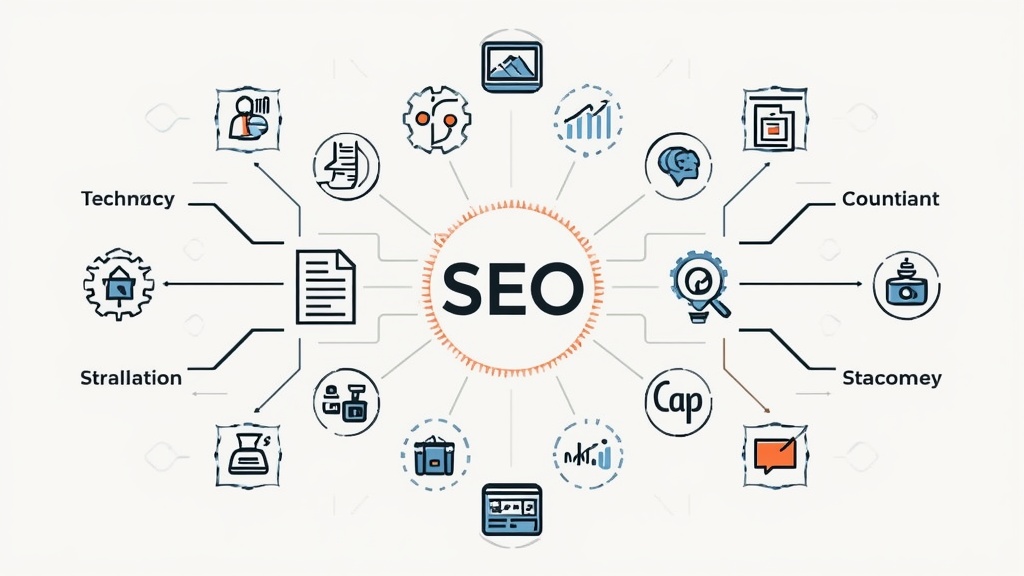
Navigating the intricate landscape of search engine optimization can feel daunting, especially when industry jargon obscures the path to improved website visibility and increased organic traffic. This glossary aims to demystify these concepts, translating complex terminology into clear, actionable strategies for your digital growth.
As Vagner Dias, my mission is to empower website owners by simplifying these processes. This guide serves as a straightforward reference, explaining the foundational seo terms related to technical setup, content strategy, and link building. By mastering this vocabulary, you will gain the clarity needed to effectively audit your site, conduct informed keyword research, and make data-driven decisions that genuinely enhance your online presence.
What is SEO and Why Vocabulary Matters
Quick answer: SEO terms are the specific language used in search engine optimization, encompassing technical setup, content creation, and link-building strategies. Understanding these concepts is fundamental for boosting website visibility, driving organic traffic, and mastering digital marketing. This glossary simplifies complex jargon into plain English, empowering you to confidently manage audits, keyword research, and performance analytics.
Defining Search Engine Optimization
At its heart, search engine optimization is the strategic process of refining your website to achieve higher rankings on search engine results pages (SERPs). When a user enters a query into a search engine like Google, the engine scans its vast index to identify the most relevant and authoritative content. By aligning your site with these critical ranking factors, you significantly increase the probability of appearing before your target audience.
However, successful SEO involves more than simply inserting keywords. It necessitates a delicate balance between technical website health, the creation of high-quality content, and the acquisition of external validation. To truly understand the mechanics behind search engine rankings, it is imperative to first familiarize yourself with the fundamental seo terms that govern how search engines interact with your web pages.
How SEO terms influence your content strategy
In practical application, this shared vocabulary acts as a crucial bridge between technical requirements and creative content development. For instance, understanding the distinction between a “meta description” and an “H1 tag” directly influences how you structure and write your web copy. Without this common language, effectively communicating with developers or accurately interpreting performance data from your analytics dashboard becomes a considerable challenge.
Furthermore, mastering these concepts allows you to move beyond guesswork. When you grasp the implications of an “algorithm” update or the significance of “domain authority,” you can strategically pivot your approach based on concrete evidence rather than fleeting trends. This level of clarity is an invaluable asset for any website owner, transforming potentially intimidating technical documentation into a clear, actionable roadmap for sustained growth.
Consequently, your decision-making process becomes both faster and more precise. Instead of feeling overwhelmed by industry jargon, you can critically analyze your site’s health and performance. Therefore, cultivating a robust understanding of these terms is not merely an academic pursuit; it is a practical and essential step toward achieving long-term digital success. Regardless of whether you manage a small blog or a large e-commerce platform, these definitions will equip you with the primary toolkit needed to navigate the competitive online landscape.
Essential Technical SEO Terms
Quick answer: Technical SEO pertains to the backend infrastructure of your website, enabling search engines to discover, read, and organize your pages. Mastering these specific seo terms is vital, as even exceptional content may struggle to rank if search engine bots encounter technical impediments during their site evaluation processes.
Crawling and Indexing explained
At the most fundamental level, search engines employ automated programs, often referred to as “bots” or “spiders,” to discover online content. This discovery process is known as crawling. Envision a librarian meticulously navigating an extensive library; they must visit every shelf to ascertain the available books before cataloging them. Similarly, if your site is not crawlable, search engines simply cannot detect your efforts.
Following the discovery phase, the bot proceeds to the indexing stage. This is where the search engine stores and organizes the gathered information within its massive database. A page that is successfully indexed becomes eligible to appear in search results for relevant queries. For instance, if you publish a new blog post but it remains unindexed, your content will be invisible to users, irrespective of its quality.
What is a Canonical Tag?
In practical terms, websites frequently feature multiple pages with nearly identical content, which can lead to confusion for search engines. A canonical tag is a specific HTML element designed to inform search engines which version of a page should be considered the “master” or preferred copy. By implementing this tag, you effectively prevent duplicate content issues that could otherwise dilute your site’s authority and ranking potential.
For example, if a product page can be accessed through various URL parameters, search engines might interpret these as distinct pages. Utilizing a canonical tag ensures that all associated ranking signals, including link equity, are consolidated into one primary URL. Therefore, this straightforward technical implementation is crucial for maintaining a clean and well-structured site architecture.
Beyond these core concepts, technical SEO encompasses other critical elements such as “robots.txt” files and “XML sitemaps,” which serve as navigational guides for search engines, enhancing their ability to traverse your site efficiently. Understanding these foundational seo terms not only improves communication with developers but also empowers you to make informed decisions regarding your website health. Ultimately, a robust technical foundation is indispensable for all future growth and organic traffic acquisition.
On-Page SEO and Content Vocabulary
Quick answer: On-page SEO focuses on optimizing individual web pages to achieve higher rankings and attract more relevant traffic. By mastering these seo terms, you can effectively structure your content, enhance readability for users, and help search engines accurately interpret your website’s primary subject matter, leading to improved organic performance.
Understanding Search Intent
Search intent represents the underlying goal or purpose a user has when formulating a query in a search engine. In practice, accurately identifying this intent is paramount because it dictates the precise type of content you should develop. For instance, if a user searches for “best running shoes,” they are most likely seeking a comparative review or a curated list, rather than a direct checkout page.
Moreover, search engines like Google prioritize pages that effectively satisfy this underlying user need. When your content precisely addresses what a user is looking for, they are inclined to spend more time on your page, signaling relevance and value. Consequently, aligning your content strategy with user goals is a fundamental aspect of modern search engine optimization.
Title Tags vs. Meta Descriptions
These two elements constitute the primary components of your website’s appearance on a search engine results page (SERP). The Title Tag serves as the clickable headline, typically displayed in blue; it is the most significant signal to both users and search algorithms concerning your page’s topic. Therefore, ensuring it is concise and descriptive is crucial for initial visibility.
Conversely, the Meta Description is the brief descriptive text that appears beneath the title. While it does not directly impact search engine rankings, it functions as a compelling advertisement for your page. An engaging and relevant meta description can significantly increase your click-through rate (CTR), which in turn provides positive signals to search engines about your site’s relevance and appeal.
In addition to these, other vital on-page seo terms include header tags (H1 through H6), which are essential for organizing content hierarchy, and alt text for images. Employing descriptive alt text not only aids screen readers for accessibility but also helps search bots interpret visual media, thereby enhancing overall comprehension of your page’s content. Collectively, these elements work in synergy to craft a structured and professional online presence that is easily navigable for both users and search engines.
For individuals seeking to deepen their understanding, consulting industry-standard glossaries can effectively clarify how these components integrate into a comprehensive technical SEO strategy. Subsequently, you can begin applying these principles to your WordPress site to observe tangible improvements in your content structure and search performance.
Off-Page SEO and Link Building Terms
Quick answer: Off-page SEO encompasses actions taken outside your own website to influence its ranking on search engine results pages. This process primarily involves link building, where earning high-quality backlinks acts as a strong signal of trust to search engines, ultimately enhancing your site’s credibility and overall visibility.
Backlinks and Link Equity
A backlink is essentially a hyperlink from one website that points to another. In the context of search engines, these links are interpreted as endorsements or “votes of confidence.” Crucially, not all backlinks carry equal weight. When a reputable and authoritative website links to your content, it passes “link equity”—a measure of authority and trust—to your pages.
In practice, concentrating on the quality of these inbound links yields far more effective results than pursuing a high quantity of low-quality links. For instance, a single link from a well-established industry publication is significantly more valuable than dozens of links originating from irrelevant or spammy websites. To further clarify the nuances of these important seo terms, reviewing a professional glossary can be highly beneficial.
What is Domain Authority?
Domain Authority is a proprietary metric developed by Moz that predicts how likely a website is to rank on search engine results pages. While it is not a direct ranking factor utilized by Google, it serves as a valuable benchmark for comparing your site’s overall strength against that of your competitors. Moreover, it provides an indicator of the robustness and relevance of your backlink profile over time.
Cultivating domain authority is a gradual process that requires consistent effort. It involves the continuous creation of high-quality, valuable content that naturally attracts mentions and references from other reputable sources. Therefore, prioritizing the development of genuine relationships within your niche, rather than employing manipulative tactics for link acquisition, is paramount. For those embarking on their SEO journey, our SEO training offers a solid foundation for understanding how these external factors integrate into your broader optimization strategy.
Consequently, your website gradually becomes perceived as more trustworthy by both users and search engine algorithms. Always remember that off-page optimization is a long-term commitment. By consistently monitoring your backlink profile and ensuring your content remains valuable and relevant, you establish a sustainable and authoritative online presence. For those seeking a deeper dive into the technical intricacies of these seo terms, consulting an industry-standard glossary will facilitate a clearer understanding of complex concepts.
Keyword Research Terminology
Quick answer: Keyword research forms the bedrock of effective search engine optimization. It involves identifying the precise words and phrases that users type into search engines when seeking information. By mastering these essential seo terms, you can more accurately align your content with user needs, ultimately driving more targeted organic traffic to your website.
Short-tail vs. Long-tail Keywords
Short-tail keywords, often referred to as “head” terms, typically consist of one or two words. For example, the term “shoes” represents a broad, short-tail keyword. While such terms generate substantial search volume, they are exceptionally competitive and frequently lack the specific context needed to understand the user’s precise intent.
Conversely, long-tail keywords are longer, more descriptive phrases, generally comprising three or more words. A phrase like “best waterproof running shoes for trail running” is a clear illustration of a long-tail keyword. Although these specific phrases exhibit lower individual search volume, they often signal a significantly higher intent to purchase or engage with the content.
In practical application, prioritizing long-tail keywords presents a strategic advantage, particularly for smaller websites. Due to their inherent specificity, they typically face less competition compared to broad, short-tail terms. As a result, you can achieve rankings more rapidly and attract visitors who are more likely to find precisely what they are looking for on your pages.
Search Volume explained
Search volume quantifies the average number of times a particular keyword is searched for within a search engine over a defined period, most commonly on a monthly basis. It serves as a primary metric for gauging the potential popularity and demand for a given topic. High search volume indicates widespread interest, but it does not inherently guarantee successful ranking or traffic generation.
Furthermore, it is crucial to consider the inherent difficulty of ranking for high-volume terms. Keywords with massive search volume are frequently dominated by established industry leaders with substantial authority. Therefore, it is essential to strike a balance between search volume and your website’s current ranking capabilities. Sometimes, targeting a lower-volume, highly relevant keyword can yield a superior return on investment.
Subsequently, you should meticulously analyze the search intent behind those high-volume terms. If the user’s intent does not align with the content you provide, even achieving a high ranking position may result in a high bounce rate. Above all, successful keyword research hinges on identifying the optimal intersection between what people are actively searching for and what your website has to offer.
By consistently applying these principles, you transform abstract seo tips into a concrete and actionable content roadmap. Always remember that keywords are not merely numerical data points; they represent the actual questions and problems your target audience is striving to solve on a daily basis.
Analytics and Performance Metrics
Quick answer: Analytics and performance metrics are essential seo terms used to track user interaction with your website. By monitoring data such as bounce rate and conversion rates, you gain critical insights into your site’s health and effectiveness. These metrics enable you to refine your digital strategy, ensuring your content effectively attracts visitors and encourages them to take meaningful actions.
A thorough understanding of website data is the only reliable way to ascertain if your optimization efforts are yielding the desired results. Without consistent performance tracking, you are essentially operating on assumptions regarding which changes positively impact your search engine optimization outcomes. Most professionals utilize tools like Google Analytics to gather this vital information, transforming raw numbers into a clear roadmap for future improvements and strategic adjustments.
Bounce Rate vs. Engagement
Historically, bounce rate was the primary metric employed to determine if a user departed a page without interacting further. However, this definition has evolved significantly. In contemporary web analytics, a high bounce rate does not invariably signify content failure; for instance, a visitor might find the exact phone number they need on your landing page and leave immediately, which constitutes a successful outcome.
Rather than solely focusing on bounce rates, it is more beneficial to consider engagement metrics. This metric tracks users who spend a significant duration on a page (e.g., more than ten seconds), trigger a conversion event, or navigate to multiple pages within your site. By shifting your analytical focus toward engagement, you acquire a more nuanced and accurate perspective on how your seo terms and the overall quality of your content align with user expectations and behaviors.
Conversion Rate basics
Conversion rate precisely measures the percentage of website visitors who successfully complete a predetermined desired action. This action could range from filling out a contact form, subscribing to a newsletter, or completing a purchase. For business owners, this is arguably the most critical metric, as it directly bridges the gap between simply attracting traffic and actively growing revenue.
To enhance your conversion rates, begin by meticulously auditing your calls-to-action (CTAs) to ensure they are prominently displayed and compelling. Furthermore, you should conduct A/B testing on different page layouts and content variations to identify which versions yield the highest results. If your website experiences high traffic but low conversions, it may indicate that your content is attracting the wrong audience or failing to adequately address their specific needs. Therefore, continuous analysis of these key metrics empowers you to adjust your strategy based on actual user behavior rather than unsubstantiated assumptions.
In practice, integrating these analytical habits into your regular website management routine will render your operations far more predictable and results-oriented. Subsequently, you can leverage these valuable insights to inform your keyword research and content planning processes. By effectively connecting performance data back to your initial strategic goals, you establish a sustainable cycle of growth that ensures your site remains competitive within the ever-evolving search landscape.
Advanced SEO Jargon Explained
Quick answer: Moving beyond the foundational seo terms, advanced concepts like E-E-A-T and Schema markup provide search engines with deeper context about your content’s credibility and structure. These frameworks assist Google in verifying your authority and displaying rich results, which directly influences how your website appears and performs within competitive search engine result pages.
Understanding E-E-A-T
E-E-A-T stands for Experience, Expertise, Authoritativeness, and Trustworthiness. While not a direct ranking factor in itself, it functions as a crucial quality framework that search engines employ to evaluate the overall value and reliability of your content. For instance, if your website provides medical advice, Google will actively seek evidence demonstrating that the author possesses genuine hands-on experience or relevant professional credentials.
To enhance your site’s E-E-A-T signals, it is advisable to clearly display author biographies, cite reputable sources meticulously, and ensure your website consistently provides accurate, up-to-date information. Moreover, this dedicated focus on content quality helps establish your site as a dependable resource within your specific niche. Consequently, users are more inclined to trust your brand, which often translates into improved long-term performance and search visibility.
Schema Markup for beginners
Schema markup, also known as structured data, is a specialized form of code that you integrate into your website’s HTML to help search engines better understand the context of your content. Think of it as a set of semantic tags that explicitly tell Google whether your page represents a recipe, a product, a customer review, or an upcoming event. By implementing Schema, you significantly increase the likelihood of your content being displayed as “rich snippets” directly within search results, such as star ratings, prices, or event dates.
In practical application, implementing Schema markup can lead to a substantial increase in your click-through rate (CTR). This is because rich snippets make your search result listing more visually appealing and informative compared to standard text-based results. For example, a local business utilizing local business schema can prominently display its address and operating hours directly in the SERP. Therefore, while it may appear technically complex, adding this layer of structured information is a powerful strategy to differentiate your website from competitors who rely solely on conventional meta descriptions.
If you are managing a WordPress site, you will likely find numerous plugins designed to automatically generate this code, eliminating the need for manual coding. Nevertheless, it remains highly beneficial to understand the underlying logic of these seo terms to ensure your structured data is correctly implemented and formatted. Subsequently, you can monitor your site’s performance within search consoles to verify that your structured data is recognized by search engines and actively contributing to your overall visibility.
Building Your SEO Strategy with Vagner Dias
Quick answer: Mastering essential seo terms is the foundational step toward constructing a sustainable and effective digital presence. By understanding the interplay between technical configurations, content quality, and link-building efforts, you can proficiently manage your website. Vagner Dias emphasizes that consistently applying these concepts within your publishing workflow is the key determinant of long-term organic traffic growth.
Applying terms to WordPress sites
In practice, the most effective method for mastering these concepts is to apply them directly within your WordPress environment. For instance, instead of viewing a “Canonical Tag” as an abstract theoretical concept, you can utilize plugins to verify how your site communicates preferred content versions to search engines like Google. This hands-on approach effectively demystifies technical jargon and makes your website management tasks feel considerably less daunting.
Moreover, structuring your content strategy around specific seo terms ensures that each page on your site serves a clear and defined purpose. When creating content, focus intently on the user’s intent rather than merely optimizing for keywords in isolation. Subsequently, ensure that your meta descriptions and title tags are compellingly optimized to encourage direct clicks from the search results page.
Tools for your SEO journey
Developing a reliable toolkit is indispensable for accurately tracking your progress and making informed decisions. Many beginners find it highly beneficial to start with free analytics platforms that provide essential data on organic traffic, user behavior, and bounce rates. Consequently, you can identify which pages are performing well and which require further optimization, basing your adjustments on real user data rather than mere speculation.
In addition, staying abreast of modern developments and emerging technologies within the SEO field is vital. As you refine your process, you may explore AI-powered tools that can assist with tasks such as keyword research or technical audits. However, it is crucial to remember that software should serve to augment your human judgment and strategic thinking, not replace it. Above all, maintaining a consistent and high-quality publishing schedule is fundamental to building authority and trust over time.
Finally, do not feel pressured to master every single SEO term overnight. Search engine optimization is a dynamic and continuous learning process. By integrating these strategies into your daily routine—such as regularly checking your search console for indexing errors or refining your internal linking structure—you will witness gradual yet significant improvements. For further guidance on effectively bridging the gap between SEO theory and practical execution, consult our practical SEO tips guide to ensure your website remains on the optimal path toward success.
Frequently Asked Questions
What are the 4 types of SEO?
The four main types are On-page SEO, Off-page SEO, Technical SEO, and Local SEO.
These four pillars represent the comprehensive approach required for modern search engine success. On-page SEO focuses on content quality and optimization, while Off-page SEO builds your site’s reputation through external signals like backlinks. Technical SEO ensures that search engine bots can efficiently crawl and index your website architecture. Finally, Local SEO is specifically designed for businesses serving geographic areas, helping them appear in maps and local search results. By mastering these four distinct areas, website owners can create a balanced strategy that addresses both the user experience and the requirements of search engine algorithms.
What is the difference between crawling and indexing?
Crawling is when search engines discover your pages; indexing is when they store and organize those pages in their database.
Think of crawling as a search engine “scout” visiting your website to read the content and follow links to other pages. This process is conducted by automated software known as bots or spiders. Once the bot has gathered the information, it sends that data to the search engine’s massive index. Indexing is the storage phase where the search engine organizes this information so it can be retrieved quickly when a user performs a search. If a page is not indexed, it cannot appear in search results, making this distinction critical for troubleshooting visibility issues on your website.
What is a backlink?
A backlink is a link from one website to another; they act as ‘votes of confidence’ that help improve site authority.
Backlinks are one of the most significant ranking factors for major search engines. When an external website links to your content, it functions as a signal of trust and credibility. Search engines interpret these links as evidence that your content is valuable enough to be cited by others. However, the quality of the link matters significantly more than the quantity. A link from a reputable, high-authority domain is far more beneficial than numerous links from low-quality or irrelevant websites. Focusing on earning natural, high-quality backlinks is a cornerstone of any long-term off-page strategy.
What is Search Intent?
Search Intent is the goal or purpose behind a user’s search query, such as wanting to learn, buy, or find a specific website.
Search intent is categorized into four primary types: informational, navigational, commercial, and transactional. Informational intent occurs when a user wants to learn something, while navigational intent means they are looking for a specific site. Commercial intent happens when a user is researching before a purchase, and transactional intent indicates they are ready to buy. When you create content that matches the specific intent of your target audience, you satisfy the user’s needs more effectively. Google rewards this alignment, as it indicates your page is the most relevant and helpful result for that specific search query.
Why is E-E-A-T important?
E-E-A-T (Experience, Expertise, Authoritativeness, and Trustworthiness) is a framework Google uses to evaluate the quality of content.
E-E-A-T is particularly vital for websites that impact a user’s “Your Money or Your Life” (YMYL) status, such as health, finance, or legal sites. Experience refers to the real-world involvement of the author, while Expertise focuses on their knowledge level. Authoritativeness measures the reputation of the site and the author within their industry, and Trustworthiness is the most important element, reflecting the overall legitimacy of the page. By demonstrating these four qualities, you signal to both search engines and human readers that your content is accurate, safe, and reliable, which is essential for building a lasting audience and achieving sustainable rankings.
What is the difference between a Title Tag and an H1?
The Title Tag appears in search engine results, while the H1 is the main headline visible to visitors on your actual webpage.
While both elements often contain similar keywords, they serve different purposes. The title tag is an HTML element that tells the search engine the title of your page, which is then displayed as the main blue link in search results. The H1 is the primary heading tag inside the body of your webpage content, which acts as the title for the reader once they have clicked through to your site. It is best practice to ensure both are optimized for the target keyword, as they provide critical context to both search engine crawlers and your site visitors.
How long does it take to see SEO results?
SEO is a long-term strategy; significant results typically take between 6 to 12 months of consistent optimization.
Search engine optimization is not an overnight fix; it requires ongoing effort and patience. The timeframe for seeing results depends on several factors, including the competitiveness of your industry, the age of your domain, and the volume of high-quality content you publish. In the first few months, you may see improvements in indexing and technical performance, but substantial increases in organic traffic usually occur after the search engine has fully assessed your site’s authority and relevance over time. Consistent, high-quality work leads to long-term compounding growth, making it a sustainable investment for small business owners and content creators alike.
What is a long-tail keyword?
A long-tail keyword is a longer, more specific phrase that usually has lower search volume but higher conversion potential because it targets users with very specific needs.
Long-tail keywords are typically three words or longer and are highly descriptive. Because they are specific, the users searching for these terms often have a very clear idea of what they are looking for, which makes them more likely to convert into customers or subscribers. While these keywords don’t bring in the massive traffic numbers associated with broad, short-tail terms, they are much easier to rank for and attract a more qualified audience. Incorporating a mix of both broad and long-tail keywords into your content strategy allows you to capture a wider range of search traffic while maintaining a focus on high-intent visitors.
Next Step
Now that you have a firm grasp of essential seo terms, the most effective way to progress is to apply these concepts directly to your own platform. Start by auditing your current content structure and identifying areas where you can improve your meta tags or internal linking strategy.
Moreover, if you are looking to deepen your expertise, you can explore our comprehensive SEO training to bridge the gap between theory and execution. Remember that consistent application is the key to achieving long-term growth in search rankings.
Finally, do not hesitate to leverage modern technology to streamline your workflow. You can check our latest review of AI tools for website SEO to find the right software to support your journey. If you need personalized guidance on your site’s performance, feel free to reach out or explore our additional practical SEO tips.